what is search engine optimization :
SEO (Search Engine Optimization) is the process of improving a website’s visibility on search engines like Google, Bing, and Yahoo. It helps businesses attract more organic (unpaid) traffic by optimizing website content, structure, and performance according to search engine guidelines. The main goal of SEO is to rank higher in search engine results pages (SERPs), making it easier for potential customers to find your products or services online.
SEO involves several techniques, including keyword research, on-page optimization, technical SEO, and link building. By using relevant keywords, creating high-quality content, improving website speed, and ensuring mobile-friendliness, businesses can enhance their online presence and reach their target audience more effectively.
In today’s digital world, SEO is an essential marketing strategy for businesses of all sizes. It not only increases website traffic but also improves brand credibility and user experience. Unlike paid advertising, SEO provides long-term benefits by generating sustainable organic traffic over time. A well-planned SEO strategy can help businesses gain a competitive advantage, increase conversions, and achieve their digital marketing goals. Investing in SEO is one of the most effective ways to build a strong and successful online presence.
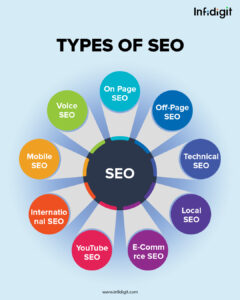
Types of SEO
Search Engine Optimization (SEO) is primarily categorized into four core types
On-Page SEO:Optimizing individual page elements (content, title tags, meta descriptions, and keywords) to rank higher and match user intent.
Technical SEO: Improving site speed, mobile-friendliness, and backend architecture to help search engines crawl and index pages efficiently.
Off-Page SEO: Building external authority and trust primarily through acquiring high-quality backlinks, brand mentions, and social signals.
Local SEO:Optimizing an online presence to attract nearby customers, prominently featuring tools like the Google Business Profile for regional searches.Depending on your specific business, these core pillars can be expanded into specialized strategies:
E-commerce SEO: Tailoring online stores for product visibility, utilizing structured data, and managing platforms like the Google Merchant Center.
International SEO:Adapting content for multiple regions and languages using hreflang tags.
YouTube SEO: Optimizing videos, descriptions, and metadata to rank well in video-specific platforms.
WHITE – HAT SEO :
White-Hat SEO is an ethical and sustainable approach to Search Engine Optimization that follows the guidelines and best practices set by search engines such as Google. It focuses on improving a website’s ranking through legitimate techniques rather than using shortcuts or manipulative methods. The primary goal of White-Hat SEO is to provide valuable and relevant content to users while enhancing the overall user experience.
White-Hat SEO practices include keyword research, creating high-quality content, optimizing website speed, improving mobile responsiveness, using proper meta tags, and earning backlinks naturally from reputable websites. These techniques help websites achieve higher rankings in search engine results pages (SERPs) without risking penalties or bans.
BLACK – HAT SEO:
Black-Hat SEO refers to unethical and manipulative techniques used to improve a website’s ranking on search engines by violating their guidelines. These methods are designed to achieve quick results rather than sustainable growth. While Black-Hat SEO can sometimes boost rankings in the short term, it carries significant risks, including penalties, loss of rankings, or even complete removal of a website from search engine results.
Common Black-Hat SEO techniques include keyword stuffing, cloaking, hidden text, duplicate content, link farming, and purchasing backlinks. These practices attempt to deceive search engine algorithms instead of providing valuable and relevant content to users. For example, keyword stuffing involves overusing keywords unnaturally in web content, while cloaking presents different content to search engines and users.
Search engines continuously update their algorithms to identify and penalize websites that use Black-Hat SEO practices. As a result, businesses that rely on these tactics often face long-term damage to their online reputation and visibility.
Although Black-Hat SEO may seem like a shortcut to higher rankings, it is not a reliable or sustainable strategy. Ethical SEO practices, commonly known as White-Hat SEO, remain the best approach for achieving lasting success and building trust with both users and search engines.
Local SEO :
Local SEO (Local Search Engine Optimisation) is the process of improving a business’s online presence so it appears more prominently in location-based search results, especially when people search for products or services in a specific geographic area.
local SEO helps relevant businesses appear in search engine results, including the local map listings and organic results.
MObile seo
you’re looking for a brief self-introduction as a Mobile SEO professional, you could use:
“I am a Mobile SEO specialist with expertise in optimizing websites for smartphone and tablet users while improving search engine visibility. I focus on responsive design, page speed, Core Web Vitals, mobile usability, technical SEO, and mobile-first indexing to enhance user experience and increase organic traffic. My goal is to ensure websites perform efficiently across all mobile devices and achieve strong rankings in search results.”
“I specialize in Mobile SEO, helping websites achieve better search rankings and user experiences on mobile devices through responsive design, faster page speeds, technical optimization, and mobile-first SEO best practices.
International SEO
International SEO is the process of optimizing a website so that search engines can identify which countries and languages your content is intended for. Its goal is to help users in different regions find the most relevant version of your website in search results.
Key elements of International SEO:
Language targeting: Creating content in different languages (for example, English, Spanish, or French).
Country targeting: Serving content tailored to specific countries, even if they share the same language (such as the UK and the US).
Hreflang tags: Telling search engines which language and regional version of a page to show to users.
Search Intent
Search intent (also called user intent or keyword intent) is the purpose or goal behind a user’s search query. It explains why someone is searching and what they hope to achieve by typing a keyword into a search engine.
Search engines such as Google aim to understand search intent so they can display the most relevant results. For example, when someone searches “best smartphones under £500”, they are looking for recommendations rather than wanting to buy immediately or learn the history of smartphones.
Definition
Search intent is the underlying reason behind a search query. It reflects what information, product, service, or action a user expects to find after performing a search.
Understanding search intent is one of the most important aspects of Search Engine Optimisation (SEO) because creating content that matches user intent improves rankings, user satisfaction, and conversions.
Meta Title Optimization
Meta title optimization is the process of creating clear, relevant, and keyword-rich page titles that improve search engine rankings and attract more users to click on your website. A well-optimized meta title accurately describes the page content, includes the primary keyword naturally, and stays within the recommended length (about 50–60 characters) to avoid being cut off in search results. Effective meta titles enhance user experience, increase click-through rates (CTR), and support overall SEO performance. By writing unique, engaging, and descriptive titles for every page, businesses can improve their online visibility and drive more qualified organic traffic.
URL Optimization
URL optimization is the practice of creating clear, descriptive, and user-friendly web addresses that help both search engines and visitors understand a page’s content. Well-optimized URLs are typically short, include relevant keywords, use hyphens to separate words, avoid unnecessary parameters or random characters, and reflect the site’s content hierarchy. Effective URL optimization can improve usability, make links easier to share, and support search engine indexing
Google Analytics for SEO
Google Analytics for SEO is the practice of using Google Analytics 4 (GA4) to measure and improve a website’s performance in organic search results. It helps website owners understand how visitors from search engines interact with their site by tracking metrics such as organic traffic, user engagement, page views, session duration, and conversions. By analyzing this data, businesses can identify high-performing pages, improve underperforming content, and optimize the overall user experience. When combined with Google Search Console, Google Analytics provides valuable insights into SEO performance, helping marketers make data-driven decisions that increase search visibility, website traffic, and business growth.
Domain Authority
Domain Authority (DA) is a search engine ranking score developed by Moz that predicts how likely a website is to rank on search engine results pages (SERPs). The score ranges from 1 to 100, with higher scores indicating a greater ability to rank well in search results. Although Domain Authority is not a Google ranking factor, it is widely used by SEO professionals to evaluate a website’s overall strength and compare it with competitors.
Domain Authority is calculated using multiple factors, including the number of high-quality backlinks, the relevance of linking websites, the overall quality of content, website structure, and the site’s overall SEO performance. Websites that receive backlinks from trusted, authoritative sources generally achieve higher DA scores than those with fewer or low-quality links.
For example, well-established websites such as Wikipedia or major news portals often have Domain Authority scores above 90, while new websites usually start with a lower score. As a website gains quality backlinks, publishes valuable content, and improves its technical SEO, its Domain Authority can gradually increase over time.
Improving Domain Authority requires a long-term SEO strategy. Businesses should focus on creating informative and original content, earning backlinks from reputable websites, optimizing on-page SEO, improving website speed and mobile responsiveness, and maintaining a positive user experience. Removing spammy backlinks and regularly updating website content can also contribute to better authority.
It is important to remember that Domain Authority should not be viewed as the only measure of SEO success. A website with a lower DA can still rank higher than a website with a higher DA if it provides more relevant, high-quality content that better matches user search intent. Therefore, Domain Authority is best used as a benchmarking tool rather than a direct indicator of Google rankings.
In summary, Domain Authority is a valuable SEO metric that helps website owners assess their site’s competitive strength, monitor SEO progress, and identify opportunities for improvement. A higher Domain Authority often reflects a stronger online presence and a greater potential to achieve better search engine visibility.